Soul Notes: #1

Art as the Mirror of All Nature, Matthaus Merian the Elder, 1617. Numerous Jungians have used this engraving as an image of “Anima Mundi,” the World Soul.

Last summer, after writing on soul and soul loss, I said I’d have more to say about these subjects, but I was stymied by an underlying assumption that such a weighty subject requires a weighty post, or realistically, weighty tomes, such as the writings of Jung and Hillman, who took soul and psyche (they used the terms interchangeably) as their central concern.

Google on “soul,” and you get two billion hits. “Soul loss” returns 213 million. Soul has been a central concern of humans and their ancestors for millennia. The earliest known burial with evidence of rites “that one might characterize as religious”(1), is a 300,000 year old Neanderthal tomb!

So how do you begin to talk about soul in a blog post?

Eventually, two realizations emerged.

The first was that if blogging doesn’t support weighty tomes, it is perfect for writing notes, a valid and necessary form.

The second, and even more important realization was that no one needs to be introduced to the concept of soul, for they already have one. I’m pretty sure that everyone reading this post has an idea of soul – it’s one of those terms like “angel” or “demon” – even those who don’t believe in angels or souls or demons have an idea of what it is that they don’t believe in.

So I figure I pretty much get to do what I usually do here – “think out loud,” in this case on the notion of soul, without any expectation that my ideas may or should match anyone else’s, though I suspect we think alike about many things connected to soul ( True or False – The music of B.B. King has soul? ).

I’m speaking of something in each of us, something we feel but cannot define, which carries supreme importance and value. No matter how badly I may have screwed up this day, this month, this year, this life, if I am in touch Soul, there remains something precious within something within me of value. Soul carries a sense of what’s holy. According to James Hillman, soul is intimately connected with love, religion, beauty, and mortality.

I take the position of Jung and Hillman, that soul, aka psyche, resides in the imaginal world, between the physical realm, which is apparent, and the spiritual, which is beyond our senses and ordinary conceptions. Jung said, “The psyche creates reality every day.” Hillman added, “To be in soul is to experience the fantasy in all realities and the basic reality of fantasy.” (2)

Soul carries meaning and purpose and keeps us energized when we’re on the right path. It is present at moments of great beauty, joy, or loss, and is always a part of any “peak experience.”

T.S. Eliot said:

I am moved by fancies that are curled
Around these images, and cling:
The notion of some infinitely gentle
Infinitely suffering thing.

So this is what I am going to reflect on here for a while, and we will see where it goes. The obvious question is “Why now?”

I suspect the answer has to do with the belief of many indigenous cultures, that soul can be lost by individuals and groups, but that it also has the possibility of being retrieved. Enough said…

Cycles, Gyres, and Yugas, Part 3: Soul in a Dark Time

Edvard Munch, “The Lonely Ones,” woodcut, 1899

“the darkness around us is deep.” – William Stafford, 1960

“In a dark time, the eye begins to see,
I meet my shadow in the deepening shade;
I hear my echo in the echoing wood—
A lord of nature weeping to a tree.” – Theodore Roethke, 1963

“There’s a darkness at the edge of town.” – Bruce Springsteen, 1978

In a recent post I quoted Sri Daya Mata (Faye Wright), successor to Paramahansa Yogananda as president of Self-Realization Fellowship, describing a vision she had on a pilgrimage to the Himalayas in 1963:

“A huge black cloud suddenly swept over me, trying to engulf me. As it did so, I cried out to God…Through the practice of meditation, the all-knowing power of intuition develops in each one of us. I had intuitively understood what the Divine was telling me though this symbolic experience. It foretold a serious illness I was soon to undergo; and it also indicated that all mankind would face a very dark time during which the evil force would seek to engulf the world.

Daya Mata’s vision came to mind during the 2nd Democratic debate on July 30, when Marianne Williamson, a candidate I had initially dismissed as a lightweight, made the most pertinent observation of the evening:

“If you think any of this wonkiness is going to deal with this dark psychic force of the collectivized hatred that this president is bringing up in the country, then I’m afraid that the Democrats are going to see some very dark days.”

Both the concept of world ages and that of dark forces are pertinent metaphors for something we sense – and most cultures have explicitly believed – there are forces greater than what we can see behind and within what unfolds in the visible world.

An especially important image for me, is Soul as James Hillman used the word, (as when we say someone or something “has soul”), and the parallel image of soul loss. This metaphor has grown in importance for me as I’ve recently read both Hillman’s and his colleague, Michael Meade’s speculations on what loss of soul can mean for an individual or culture: Continue reading

James Hillman on “The Soulless Society”

I often wonder what James Hillman (1926-2011), the most widely known post-Jungian thinker and someone whose work continues to inspire me, would make of our current times.

Yesterday I found a clear indication in this excerpt from an interview, published on youTube four months before he died of bone cancer. To me, this brief conversation ( just over seven minutes) is far more important to consider than any other message I’ve seen on the eve of our nation’s birthday. In it, Hillman says:

“Where are we now? What’s psychology worth now? I mean look at the world, look at the USA. Look at all the people who have taken psychology courses and look at the lack of psychology in our government and in our attitudes. I mean we haven’t a clue!

We go around the world as if there was no such thing as a psyche, no such thing as a soul. I mean we bomb and exploit and take and kill as if this had no effect on the soul of our own people, let alone other people…I’m worried about the soul of our country from the effects of what we do.” Remember – this was said in 2011.

Hillman’s was never a “comfortable” psychology, for he always aimed to help us “see through” our comfortable illusions, ever deeper into the often uncomfortable dynamics that underly what is visible on the surface of personal and national life.

Some of the comfortable illusions I would like to believe but cannot include ideas like:

  • Our problems began in 2016.
  • One man (or) one party is responsible.
  • We are better than this.

This last one I find to be the most harmful illusion of all, for it suggests there may be (relatively) straightforward fixes, as if we simply got off on the wrong freeway exit.

If we were better than this, it wouldn’t be happening!

And if we aspire to be better than this, Hillman would likely suggest we take a clear eyed a look at where we are, and how we got here, and what we can do now in service to Anima Mundi, the Soul of the World.

Boiling Frogs

Barbed Wire. Photo by Javardh on Unsplash

Some 20 years ago, I came upon an online article by an elderly German man, responding to a question those of his generation were often asked – “How could you let the Holocaust happen?”

He said it came about over time, in incremental steps – like the old story of boiling a frog by turning the heat up slowly. “There was never a single incident so different from the ones that proceeded it that large numbers of people had a reason to take to the streets…By the time rumors of a ‘final solution’ reached us, we were too dispirited and fully compromised.”

Ten months ago, Ben Ferencz, age 99, the last surviving prosecutor from the Nuremberg trials, called the Trump administration’s family separation policy, a “crime against humanity.”

“It’s a crime against humanity. We list crimes against humanity in the Statute of the International Criminal Court. We have ‘other inhumane acts designed to cause great suffering.’ What could cause more great suffering than what they did in the name of immigration law?” Common Dreams, August 8, 2018

The administration’s chaos style of governance effectively pushed the issue out of mind through its regular deluge of outrageous acts. Fortunately, one clueless administration lawyer may have turned the heat up too high by claiming that it is “safe and sanitary” to deny soap and toothbrushes to immigrant children, and have them sleep on concrete floors under bright lights (1). This appears to have set off a firestorm of outrage – hopefully enough to to spur some action.

Here are some links to various takes on the situation, beginning with some concrete suggestions on what concerned people can do to #CloseTheCamps:

What You Can Do to Close the Camps.

AOC’s Generation Doesn’t Presume America’s Innocence.  Argues that the right fears naming the concentration camps for what they are because only “bad countries” have concentration camps.

An Expert on Concentration Camps Says That’s Exactly What the US is Running at the Border. “Many of the people housed in these facilities are not “illegal” immigrants. If you present yourself at the border seeking asylum, you have a legal right to a hearing under domestic and international law.”

America Was Never Great. Behind the Flag is a Harrowing History. The shadow cannot be ignored if an individual, an organization, or a nation is to grow.

A Firsthand Report of Inhumane Conditions at a Migrant Children’s Detention Facility

Detained Migrant Children Denied Adequate Food, Water, and Sanitation in Texas.

If Your Church is Silent Right Now, You Should Leave it.

James Hillman on Educating the Imagination

It’s no surprise to discover that the roots of our current national tribulations have deep roots. James Hillman died in 2011. I am unable to find a date for this talk, but he references the administration of George W. Bush, so I’m guessing at least a decade.

It is just as true or more so today. Please listen – it will be a most valuable half hour!

https://www.youtube.com/watch?v=cuYg3QKj2K4

A Buddhist Statement on the Separation of Families

“Whatever the legal status of those attempting to enter the US, separating children from their parents is a contravention of basic human rights. Parents seeking asylum make long, dangerous and arduous journeys in an attempt to find safety and well-being for their precious children. Ripping these vulnerable children from their parents is cruel, inhumane, and against the principles of compassion and mercy espoused by all religious traditions…

Separating children from their parents and holding them in detention inflicts terrible and needless trauma and stress on young children that hampers and damages their development, causing long-term damage. This policy being employed on United States soil is morally unconscionable. That such egregious actions be employed as a deterrent for families seeking entry and/or asylum in the U.S. – using the sacred bond between innocent youth and their parents – is unjustifiable on any level.”

A Statement on the Separation of Families.

A change coming

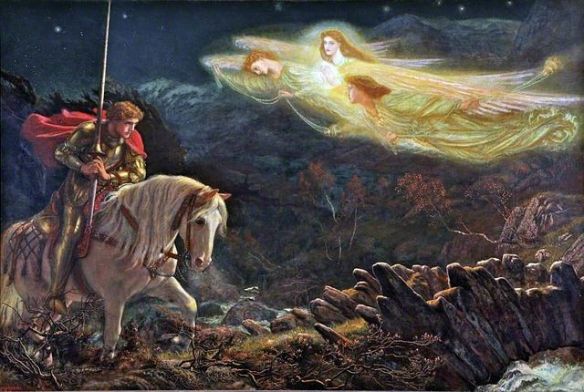
Sir Galahad, the Quest for the Holy Grail, by Arthur Hughes, 1870, public domain.

I’ve been enjoying the recording of a discussion at a conference with James Hillman and Michael Meade on literal, psychological, and mythological modes of understanding.

Hillman, a former director of the Jung Institute in Switzerland, has been the most prolific and influential of post-Jungian thinkers. He spent his life as champion of psyche, soul, and imagination in a world that has too few such champions. Hillman took particular aim at literalism, which he called “an idol that forgets it is an image and believes itself a God, taking itself metaphysically, seriously, damned to fulfill its task of coagulating the many into singleness of meaning which we call facts, data, problems, realities.” (Revisioning Psychology).

When I think of literalism, I recall the last lines of a poem a brilliant young poet I knew wrote about his high school principal:

His triple-breasted chin, arranged in folds upon his chest,
He blunts my life with a technicality.

Hillman also takes aim at much psychological thinking in books like The Soul’s Code. In this conference, he points to the 20th c. understanding that “The Gods now live in the psyche,” as a core statement of one of our greatest collective problems: the world and nature have lost their connection to the divine, and as such, are ripe for exploitation by greedy men who have traded their souls for profit. If you’ve seen one redwood, you’ve seen them all,” Ronald Reagan famously said when he was California’s governor.

Michael Meade noted that one of the hallmarks of myth is a sense of abundance. The current miasma of scarcity thinking – that there isn’t enough to go around, so you better get yours while you can – is a clear indication, if we need it, that we have no myth, no shared stories of who we are as a people. Continue reading

The White Snake – An Enigmatic Tale from the Brothers Grimm

Illustration for “The White Snake” by Walter Crane, ca. 1886, Public Domain

I once had a professor who made an extensive study of world folklore and said the greatest predictor of success for a fairytale hero is winning the help of an animal guide. Most often, the helpful animals are mammals, like Puss-in-Boots or talking horses.

“The White Snake,” a story from the Brothers Grimm, alters this pattern in startling ways. The helpful creatures are far more primitive, and the hero actually kills his horse – yet things come out right. The story has stayed with me since I first encountered it, as a wisdom tale centered on the theme of knowing the right thing to do at the right time, even when it violates norms and expectations.

Commentary on myth and folktales is a recent tradition that arose after the old ways of absorbing these stories, around hearth and campfire, disappeared. We can imagine earlier listeners holding the stories in imagination, letting the magic sink in over time, as we do with favorite novels and movies. This is a great way to experience a story, and we’re fortunate to have a good eight minute recording of The White Snake, accompanied by the text from the Brothers Grimm.

I suggest you read and listen to the story if you don’t know it, for the rest of this post will simply be my reflections on a few of the key questions The White Snake raises. Continue reading